Physical Address
304 North Cardinal St.
Dorchester Center, MA 02124
Physical Address
304 North Cardinal St.
Dorchester Center, MA 02124

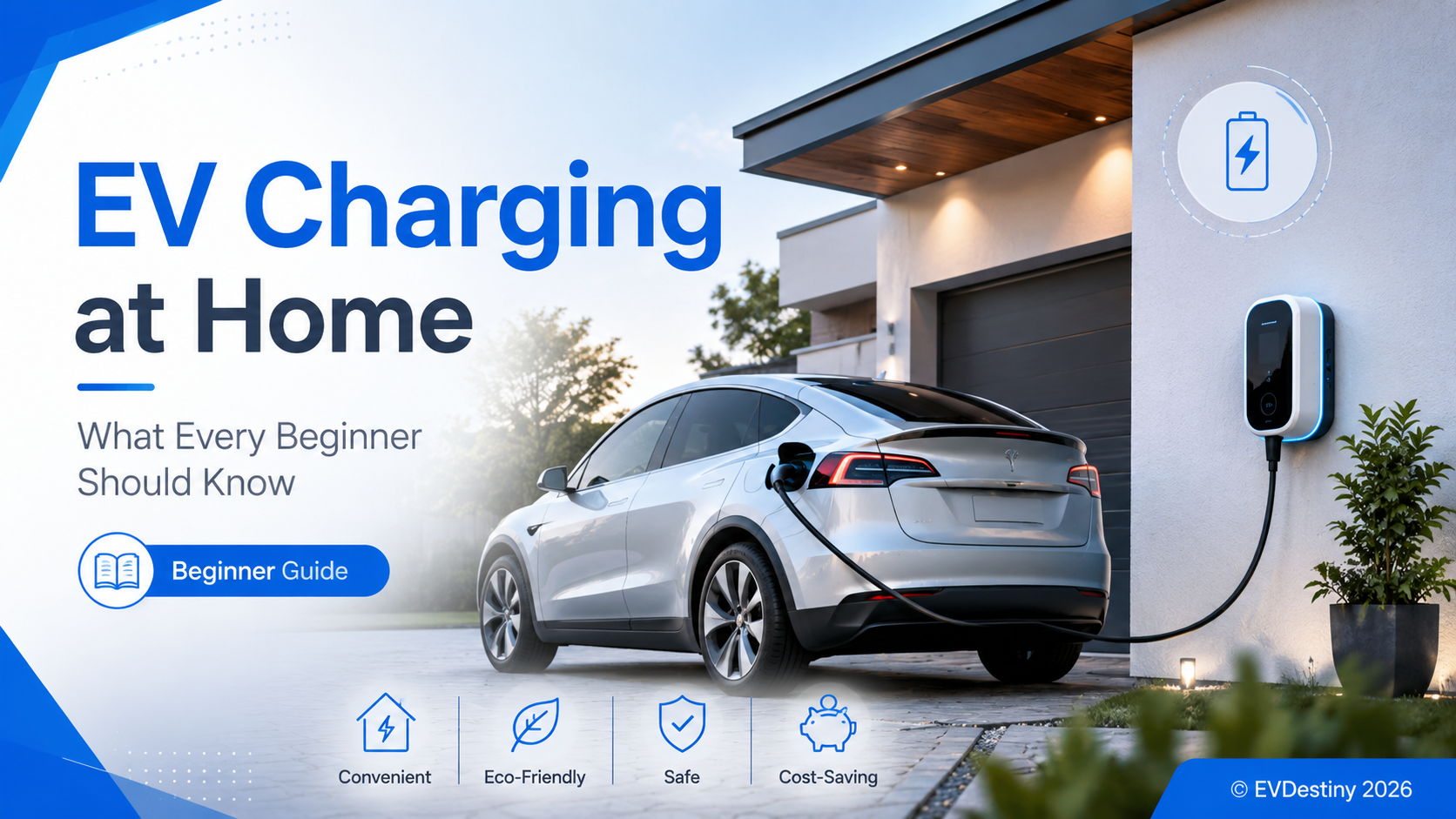
Electric vehicles are becoming more practical for everyday transportation, and one of their biggest advantages is the ability to charge them without visiting a fuel station. With EV charging at home, drivers can connect their vehicles in the evening and start the next day with enough battery power for their regular journeys.
However, new EV owners often have questions about charger types, charging speed, installation costs, electricity use, and safety. Understanding these basics can help you choose the right home charging solution and avoid unnecessary expenses.
Most electric vehicle owners use either basic household charging or dedicated home charging equipment. The best choice depends on your daily driving distance, vehicle battery size, available electrical capacity, and parking location.
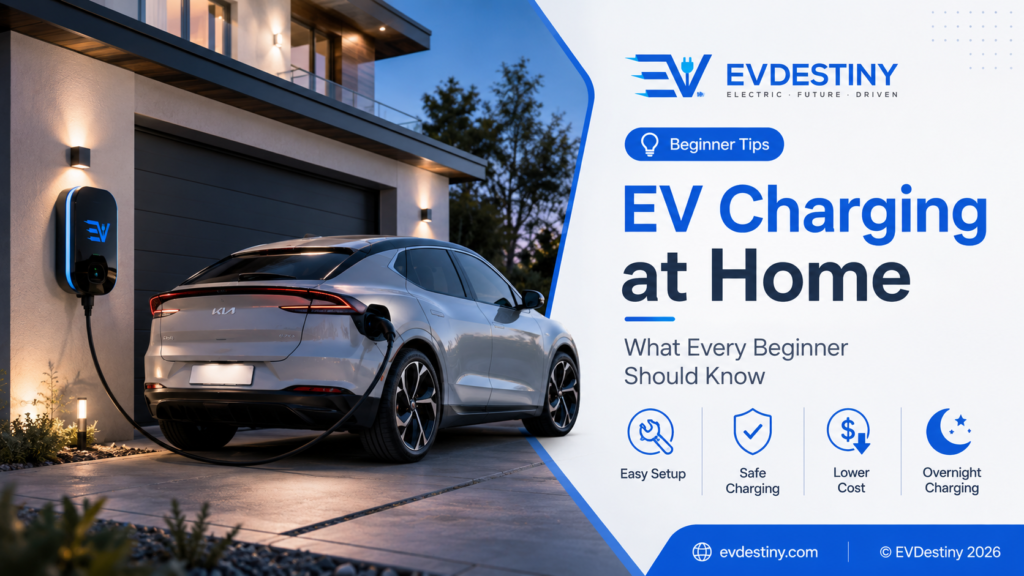
EV charging at home means connecting an electric vehicle to a power supply located at your house, garage, driveway, or private parking space.
The electricity travels through the charging cable and is converted into energy that can be stored in the vehicle’s battery. The vehicle’s onboard charging system controls how much power enters the battery and helps protect it during the charging process.
Most EV drivers charge overnight using basic AC charging or a faster dedicated home wall charger. The U.S. Department of Energy explains that home charging is commonly completed using Level 1 or Level 2 charging equipment.
Home charging equipment is also known as Electric Vehicle Supply Equipment, commonly shortened to EVSE. Although people usually call it a charger, part of the charging technology is actually located inside the vehicle.
Home charging allows an electric vehicle to gain energy while it is parked. Instead of making a separate journey to a public charging station, drivers can connect their EV after returning home.
The main benefits include:
Home charging is especially useful for people who drive a predictable distance each day. ENERGY STAR notes that many drivers may be able to meet their regular driving requirements by charging primarily at home.
Public chargers are still helpful for long-distance journeys, emergencies, and drivers without private parking. However, home charging can handle a large percentage of everyday charging needs.
The two main home charging options are Level 1 and Level 2 charging. The names and electrical specifications may vary between countries, but the general difference is charging power and speed.
Level 1 charging normally uses a standard household electrical outlet and the portable charging cable supplied with the vehicle.
It is usually the simplest option because it may not require the installation of dedicated charging equipment. However, it is also the slowest charging method.
Level 1 charging may be suitable for:
ENERGY STAR states that a typical 120-volt Level 1 charger can add approximately 2 to 5 miles of driving range for each hour of charging, although the actual result depends on the vehicle and conditions.
Before regularly using a household outlet, have it inspected to confirm that it is in good condition and suitable for continuous vehicle charging.
Level 2 charging uses a dedicated higher-power electrical connection and normally requires a home charging unit or wallbox.
It is significantly faster than basic household charging and is often the preferred solution for fully electric vehicles with larger batteries.
Level 2 charging may be suitable for:
A licensed electrician may need to install a dedicated circuit, upgrade wiring, or check whether the home’s electrical panel has enough available capacity. The Department of Energy recommends using safety-certified equipment and having a qualified electrical contractor assess the property.
Home charging time depends on several factors:
A small battery connected to a dedicated wall charger may charge overnight, while a large battery connected to a basic household outlet may require considerably more time.
The charger’s advertised power is not the only factor. Every electric vehicle has a maximum AC charging rate. For example, connecting a vehicle that accepts a lower AC rate to a more powerful charger will not force the vehicle to charge above its supported limit.
Charging speed can also decrease when the battery approaches full capacity because the vehicle’s battery management system may reduce power to protect the battery.
For most beginners, the better question is not, “How long does a complete charge take?” Instead, consider how many miles or kilometers you normally drive and how much energy must be replaced each night.
Before purchasing a home EV charger, check the vehicle, property, and electrical system.
Review the vehicle manual or manufacturer’s website to confirm:
The connector must be compatible with the vehicle. Connector standards differ by vehicle model, manufacturer, and country.
The charging cable must comfortably reach the vehicle’s charging port without being stretched across a busy walkway.
Consider:
For an outdoor installation, use equipment specifically rated for outdoor and wet conditions. The Department of Energy notes that outdoor home charging can be safe when properly rated equipment is used.
An electrician should evaluate whether the existing electrical panel and wiring can support the additional charging load.
The inspection may include:
Some homes may need only a dedicated circuit, while others may require a panel, wiring, or electrical service upgrade.
The most powerful charger is not always the best charger. Select one that matches your vehicle, driving habits, electrical supply, and budget.
Choose a charger that can provide enough energy during the hours your car is normally parked.
A very high-powered home charger may offer little additional benefit when the vehicle cannot accept the charger’s full output.
The cable should reach the vehicle comfortably without creating a trip hazard. Also consider whether your next vehicle might have its charging port in a different position.
A tethered charger has a permanently attached cable. It is convenient because the cable is always ready to use.
An untethered charger has a socket and requires a separate charging cable. It can create a cleaner appearance and may offer more flexibility when vehicles use different connectors.
A smart EV charger may provide:
ENERGY STAR explains that some connected chargers allow owners to monitor electricity use and control the charging state remotely.
Purchase charging equipment tested and certified by a recognized safety organization. Avoid unknown equipment with unclear certification, poor-quality cables, or unsupported adapters.
ENERGY STAR recommends certified home EV charging equipment and warns that some products may display unreliable or false safety claims.
A typical installation begins with a property and electrical assessment.
Choose a location near the normal parking position. The charger should be easy to reach without placing the cable across doors, walkways, or areas where vehicles may drive over it.
A qualified electrician checks the panel capacity, wiring, circuit protection, cable route, and installation requirements.
Select a charger that works with the vehicle and meets local electrical and safety standards.
Depending on the location, you may need approval from:
The electrician installs the required wiring, circuit protection, isolation equipment, and charging unit.
After installation, the electrician should test the system and explain how to operate it safely.
Do not attempt to install a dedicated high-power EV charger without the correct electrical qualifications.
The cost of home charging includes two separate expenses:
Installation costs depend on the charger, distance from the electrical panel, wiring route, labor, permits, and whether the electrical system requires an upgrade.
The cost of an individual charging session can be estimated with this calculation:
Energy added to the battery × electricity price = estimated charging cost
For example, when 40 kilowatt-hours of energy are added and electricity costs $0.15 per kilowatt-hour:
40 kWh × $0.15 = $6.00
The actual amount drawn from the electricity supply may be slightly higher than the energy stored in the battery because some electricity is lost during the charging process.
Your real cost will depend on:
Check your electricity bill or utility application to find the price per kilowatt-hour.
Many EV owners connect their vehicles when they return home and schedule charging to begin later at night.
Some electricity providers offer lower prices during off-peak hours when overall electricity demand is lower. A smart charger or the vehicle’s built-in system can automatically begin charging during these periods.
Before creating a schedule, check:
You do not always need to wait until the battery is nearly empty. Regularly replacing the energy used during daily travel is often more convenient than completing a full charge from a very low percentage.
Home EV charging is designed to be safe when certified equipment is correctly installed and used according to the manufacturer’s instructions.
Follow these important precautions:
A qualified electrician should inspect the property and install dedicated charging equipment. This helps confirm that the circuit, wiring, panel, and protective devices are suitable for the charging load.
Do not connect an electric vehicle through an ordinary extension cord or multi-plug adapter. The Electrical Safety Foundation International advises drivers to use only manufacturer-provided or approved charging cables.
Before connecting the vehicle, check the cable, plug, connector, and charger for:
Stop using damaged charging equipment and arrange a professional inspection.
Place the cable in its holder after charging. Do not leave it where it can be driven over, crushed, twisted, or exposed to unnecessary damage.
Outdoor chargers should be designed for outdoor conditions. Do not assume that every indoor charging unit can safely handle rain, dust, heat, or direct sunlight.
Use the recommended connector, cable, charging settings, and adapters. Do not modify the charger, vehicle charging port, or battery system.
Disconnect the charger safely and request professional assistance when you notice excessive heat, burning smells, repeated circuit trips, damaged components, unusual noises, or charging errors.
Apartment residents may not have direct access to a private electrical outlet. Installing a charger in shared parking can require additional planning.
Important questions include:
A connected charger with user identification and electricity monitoring may be useful in shared parking areas.
When private installation is not possible, drivers may depend on workplace chargers, nearby public stations, retail charging locations, or chargers provided by the residential building.
A charger may not be suitable for the home’s existing panel or available electrical capacity. Arrange the assessment before making the final purchase.
A higher-rated charger cannot make a vehicle exceed its maximum supported AC charging rate.
A short cable can create daily inconvenience, while a poorly positioned cable may become a trip hazard.
Low-quality equipment may lack reliable electrical protection, technical support, software updates, or genuine safety certification.
Unapproved adapters can create compatibility and safety problems. Use only equipment approved by the vehicle or charger manufacturer.
Drivers with time-of-use electricity tariffs may pay more when charging during peak hours. Scheduling can reduce this expense.
Consider whether the household may purchase another EV, install solar panels, add battery storage, or change the parking arrangement in the future.
Some electric vehicles can charge from a suitable household outlet using manufacturer-approved charging equipment. However, charging will normally be slower, and the outlet and circuit should be inspected for continuous charging use.
It is not necessary for every driver. People with short daily journeys may be comfortable with basic charging. A dedicated charger is more useful for larger batteries, longer journeys, and faster overnight charging.
EVs are designed to manage the charging process automatically. Overnight charging is common, provided approved equipment is correctly installed and used according to manufacturer instructions.
Not necessarily. Charging frequency depends on daily travel, remaining battery percentage, access to charging, and the vehicle manufacturer’s recommendations.
Many vehicles allow owners to set a daily charging limit. The best limit depends on the battery type, vehicle instructions, and upcoming journey. Follow the battery guidance provided by the vehicle manufacturer.
Yes. Outdoor charging can be safe when the equipment and installation are properly rated for outdoor conditions.
One charger can be shared at different times when both vehicles have compatible connections. Some households install dual-port chargers or use smart load-management systems when two vehicles need regular charging.
Yes. Home electricity consumption increases because energy is being used to charge the vehicle. However, drivers are replacing some or all of their petrol or diesel expenses with electricity costs.
EV charging at home can make electric vehicle ownership easier, more convenient, and better suited to daily travel. Beginners can start by understanding their daily driving needs, checking their vehicle’s charging capability, and arranging a professional assessment of their home electrical system.
Basic household charging may be enough for drivers covering short distances, while a dedicated home wall charger provides faster and more dependable charging for larger batteries and longer journeys.
The most important steps are choosing compatible safety-certified equipment, using a qualified electrician, following manufacturer instructions, and avoiding unsafe cables or adapters.
With the correct home charging setup, drivers can connect their vehicles at night and begin each day with the energy required for work, shopping, school runs, and everyday transportation.